
You’re chatting along, and then a message ends with “IWK.” No explanation, no emoji, just three letters. Is it a joke, a shrug, or something else?
The IWK meaning in text is usually “I was kidding,” though some people use it to mean “I wouldn’t know.” This guide explains both, shows you how to tell them apart from context, and gives you realistic chat examples and ready-to-send replies. You’ll also see how IWK compares with JK and IDK, plus the mistakes people make most often.
IWK Meaning in Text: The Quick Answer
The Word IWK most often means “I was kidding.” People send it after a joke, a sarcastic line, or an exaggerated claim to say, “Don’t take that seriously.” Less often, it means “I wouldn’t know.”
Here are the meanings, from most to least common:
- I was kidding: the main reading, used right after a joke or a tease.
- I wouldn’t know: a shrug-style answer when someone can’t speak to a topic.
- I would know: rare, and only supported by a few sources.
Three quick examples:
- “I’m never talking to you again. IWK 😂” means the sender was joking.
- “You’re banned from picking the movie. IWK, you can choose.” means the sender was joking.
- “Is that place any good?” “IWK, I’ve never been.” means “I wouldn’t know.”
One honest note: documentation for IWK is thinner than for common abbreviations like JK or IDK, and slang sites don’t fully agree on which meaning comes first. Treat “I was kidding” as the strongest reading, not an unbreakable rule, and let the conversation guide you.
Other Meanings of IWK
Besides “I was kidding,” IWK can also mean “I wouldn’t know” and, rarely, “I would know.” The IWK meaning in text shifts with the message around it, so context matters more here than with most abbreviations.
IWK = I Wouldn’t Know
People use this when they lack the knowledge, experience, or involvement to answer. It sounds slightly detached, and sometimes dry or sarcastic, depending on the situation.
Zoe: Did the teacher say anything about the deadline? Priya: IWK, I wasn’t in class today.
IWK = I Would Know
This one is rare. Someone might use it to stress first-hand experience, as in “I would know, I live there.” Because support for this reading is weak, don’t assume it unless the message clearly points that way.
Not to Be Confused With IWKMS, IWKL, IWL, or the IWK Hospital
A few look-alike strings float around the internet. IWKMS, IWKL, and IWL are different terms, and slang pages give them varying, sometimes conflicting, expansions. If you see one of those, don’t apply the IWK meaning to it. Check the context or ask the sender.
Also, if you searched for “IWK hospital,” that has nothing to do with texting. IWK Health is a women’s and children’s hospital in Halifax, Nova Scotia, and the name comes from the Izaak Walton Killam Hospital for Children.
Where Does IWK Come From?
The origin of IWK is unclear. There is no documented creator, date, or platform where it first appeared, and anyone who gives you an exact year is guessing.
What we can say is that it follows a familiar pattern. Texters have long shortened common phrases into initials, as with “just kidding” becoming JK and “I don’t know” becoming IDK. “I was kidding” shrinking to IWK fits that habit. That’s a reasonable explanation, but it’s an educated guess, not a verified history.
How People Use IWK in Real Chats
People use IWK in three main ways: to clear up a joke, to soften a blunt comment, and to say “I wouldn’t know.” Here is what each looks like on different apps.
After a Joke or Sarcasm (WhatsApp and TikTok)
The most common use. Someone says something dramatic, then adds IWK so nobody panics.
Sana: I’m telling Mom you ate the last slice. Ali: WHAT? You wouldn’t. Sana: IWK 😂 relax.
TikTok comments
@kai_plays: This is the best video on the internet. @rina: Best? It’s a dog sneezing. @kai_plays: IWK 😭 but I did watch it five times.
To Soften a Blunt Comment (Instagram DM)
Sometimes a message lands harder than intended. IWK works as a quick cushion.
Maya: Your new haircut looks… different. Maya: IWK, it looks great!
Notice what happens here. The follow-up changes the mood, but the first message still happened. IWK can smooth things over, though it doesn’t erase what came before.
As “I Wouldn’t Know” (Snapchat)
When IWK answers a question, it usually means the person can’t help.
Leo: Is the new burger place any good? Dan: IWK, haven’t been yet.
How to Tell Which IWK Meaning Someone Intends
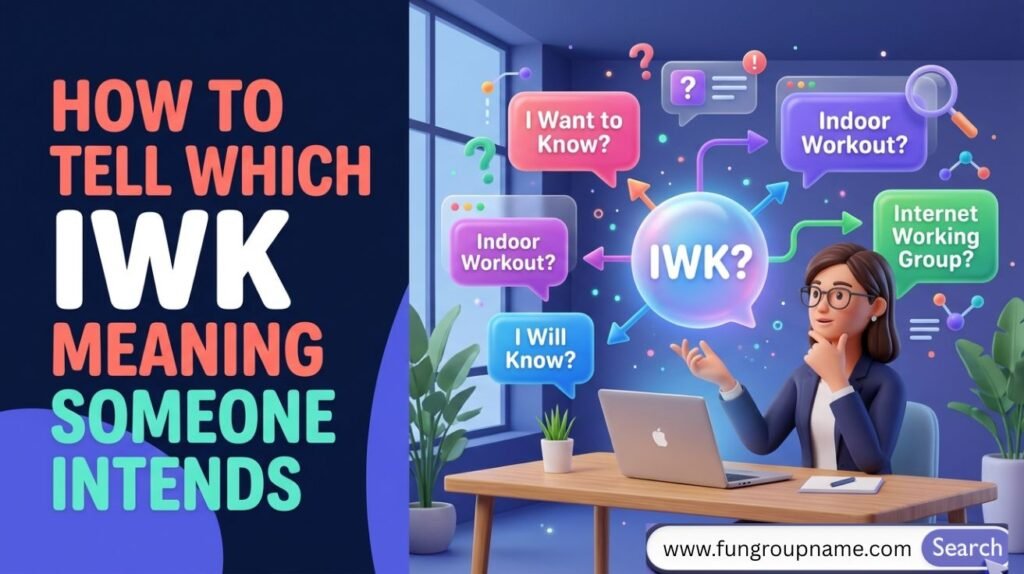
Read the message just before it, because that is where the answer usually sits. Use this quick checklist:
- Look at the previous message. If it was a joke, a tease, or an exaggeration, IWK almost certainly means “I was kidding.”
- Check whether IWK answers a question. If someone asked something and IWK is the reply, “I wouldn’t know” is the likely reading.
- Notice emojis and punctuation. A 😂 or “lol” points toward a joke. A flat, short reply points toward “I wouldn’t know.”
- Consider the mood. If the other person just reacted with shock or hurt, IWK is probably an attempt to take the comment back.
- Ask if you’re still unsure. A simple “IWK as in ‘I was kidding’?” costs you five seconds and avoids a misunderstanding.
Tone and Hidden Meaning
IWK carries different tones depending on which meaning is in play.
As “I was kidding,” it sounds playful and light. It can also signal backpedaling, especially when it follows something that could have stung. If a person sends a harsh comment and then adds IWK, the second message is often a way to avoid blame rather than a real joke.
As “I wouldn’t know,” it tends to sound neutral or a little dry. Without an emoji, it can come across as short or dismissive, even when the sender doesn’t mean it that way.
Text strips out voice and facial expression, which is exactly why abbreviations like this exist. If the tone feels off, assume less and ask more.
When to Use IWK (and When to Skip It)
Use IWK with people who share your slang and who are likely to understand it. Skip it anywhere clarity matters more than speed.
- Friends: Fine. This is where IWK works best.
- Social media: Fine in comments and DMs. JK is clearer if your audience is broad.
- Family: Older relatives may not recognize it. Write “I was kidding” in full.
- School: Fine in casual chats with classmates. Avoid it in emails to teachers or in assignments.
- Work: Skip it. Use “I was joking” or “just kidding” if you need to clear something up.
Because IWK is less widely recognized than JK, the full phrase is the safer choice whenever you aren’t sure the other person will get it.
IWK vs JK vs IDK vs Similar Terms
IWK, JK, and IDK look alike but do different jobs. JK and IWK both flag a joke, while IDK is about not knowing something.
| Term | Meaning | Tone | How widely recognized | Best used for |
|---|---|---|---|---|
| IWK | I was kidding (also: I wouldn’t know) | Playful or dry | Lower | Clearing up a joke after the fact |
| JK | Just kidding | Playful | Very high | Flagging a joke as you send it |
| JKJK | Just kidding, just kidding | Extra reassuring | Moderate | Making sure nobody takes it seriously |
| IDK | I don’t know | Neutral | Very high | Saying you lack an answer |
| IYKWIM | If you know what I mean | Knowing, sometimes suggestive | Moderate | Hinting at something unspoken |
The small grammar difference helps. “Just kidding” is present tense and often arrives with the joke. “I was kidding” is past tense, so it often arrives afterward, once the sender notices the message might have been misread.
How to Reply to IWK
Your reply depends on how the message made you feel. Here are options for each mood.
Casual Replies
- “Haha, you got me.”
- “Okay good, I almost panicked 😅”
Funny Replies
- “My heart can’t take this.”
- “You’re lucky I like you.”
Polite Replies
- “Okay, thanks for clarifying.”
- “That one landed a bit hard, but I get it.”
If IWK meant “I wouldn’t know,” a simple “No worries, I’ll ask someone else” or “Thanks anyway!” is enough.
Common Mistakes With IWK
These are the errors that cause most of the confusion.
- Reading it as “I don’t know” without checking. The meanings are close in spelling but different in purpose.
- Assuming everyone knows it. IWK is far less common than JK, so some people won’t recognize it.
- Using it in formal messages. Slang abbreviations don’t belong in professional or academic writing.
- Using it to excuse a hurtful comment. Adding IWK doesn’t undo something unkind.
- Overusing it. If every other message ends with IWK, it stops meaning anything.
Similar and Related Terms
If you’re decoding IWK, these terms often show up in the same chats:
- JK: just kidding.
- J/K: another way to write just kidding.
- JKJK: just kidding, just kidding; adds extra reassurance.
- /j: a tone tag meaning “joking.”
- /s: a tone tag meaning “sarcasm.”
- IDK: I don’t know.
- IDC: I don’t care.
- LMK: let me know.
- IYKWIM: if you know what I mean.
- IKR: I know, right? Used to agree strongly.
- LOL: laughing out loud; also used to soften a message.
- LMAO: laughing my a** off; a stronger version of LOL.
- FR: for real.
FAQs About IWK Meaning in Text
1. What is the IWK meaning in text?
IWK usually means “I was kidding.” People send it to show that a previous message was a joke or sarcasm. In some chats, it can also mean “I wouldn’t know.”
2. Is IWK the same as JK?
They are close, but not identical. Both flag a joke, but JK (“just kidding”) is much more widely recognized, and it usually arrives with the joke instead of after it.
3. Does IWK mean “I wouldn’t know”?
Yes, sometimes. When IWK is answering a question about something the sender can’t speak to, “I wouldn’t know” is the likely meaning.
4. Can I use IWK in formal messages?
No. IWK is informal slang, and many readers won’t recognize it. Write “I was joking” or “I wouldn’t know” in full.
5. Is IWK still used in 2026?
Yes, it still appears in current slang guides, but it’s less common than JK and IDK. There’s no reliable usage data on how often people send it, so treat it as a casual, lower-frequency abbreviation.
6. What is the difference between IWK and IDK?
IWK usually means “I was kidding,” while IDK means “I don’t know.” IWK can also mean “I wouldn’t know,” which is where the two overlap, but IDK is far more common for simple uncertainty.
7. Is IWK rude?
Not by itself. Whether it feels rude depends on what came before it, since a joke that hurts doesn’t become kinder because IWK follows it.
Conclusion
The IWK meaning in text is most often “I was kidding,” used to clear up a joke or soften a blunt comment. It can also mean “I wouldn’t know,” so the message before it is your best clue. Because IWK is less recognized than JK, the full phrase is safer with older readers or in formal settings. Next time you see it, read the previous message first, and if you’re still unsure, just ask.