
You open a chat and see “BYA” sitting at the end of a message. Is it a goodbye? A snarky comeback? Something else entirely?
Here’s the honest answer: the BYA meaning in text isn’t fixed. No dictionary or reference source I could find confirms one standard definition, so people read it based on context. This guide covers the most likely meanings, shows you how to tell them apart, and gives you clean examples and replies so you’re never left guessing.
What Does BYA Mean in Text?
BYA has no single official meaning in texting. It most often points to one of four readings: “because you asked,” “before you ask,” “before you assume,” or a playful “bye ya.” The conversation around it tells you which one fits.
Here are the four readings at a glance:
- Because You Asked: the sender is answering something you raised.
- Before You Ask: the sender is giving you information early.
- Before You Assume: the sender is heading off a wrong guess.
- Bye Ya: a casual, stylized goodbye.
Three quick examples:
- “Yes, I finished it. BYA 😄” (because you asked)
- “BYA, I’m not mad, just tired.” (before you assume)
- “Gotta go, bya!” (bye ya)
One caution about sources: several acronym dictionaries list BYA, but many of them rely on user submissions, so a listing there shows the phrase is in use, not that it is the “official” meaning.
BYA Meaning in Text: Which One Are You Seeing?
I couldn’t find usage data that ranks these meanings by popularity, so I won’t pretend one is the clear winner. The list below follows how often each reading shows up in the sources I checked, not how often people actually use it.
Because You Asked
This reading appears in acronym dictionaries such as AcronymFinder and AcronymsAndSlang. The sender is responding to a question or a request for information.
The tone can go either way. With a smiley, it sounds friendly. Without one, it can sound a little sharp, like “you wanted to know, so here it is.”
Before You Ask
At least one texting-meaning site lists this reading. The sender gives you the answer to a question they expect you to have, such as “BYA, I’m already home.”
It works as a quick heads-up that saves a back-and-forth.
Before You Assume
AllAcronyms lists BYA with this meaning in its slang category. The sender is correcting a likely misunderstanding before it starts, for example “BYA, this isn’t about you.”
It tends to carry a slightly defensive or clarifying tone.
Bye Ya
Some sources treat “bya” as a casual spelling of “bye ya,” similar to “see ya.” It usually sits at the end of a message, often with an emoji or exclamation mark.
There’s no documented origin for this spelling. It looks like a typing shortcut that people made up independently rather than a term with a traceable start.
Other Uses You Might Run Into
- “Beat your ass”: a TikTok discovery page describes this reading as playful banter between friends or partners. It is a mildly vulgar idiom, so it isn’t suitable for every audience. If you aren’t sure the sender is joking, ask.
- “Billion years ago”: “bya” is a standard unit-of-time abbreviation in science writing, such as geology. You won’t see it in casual chats.
- Non-slang uses: BYA also appears as the name or code of an airline, a school, and a railway station. These are reference entries, not texting slang.
Quick Comparison Table
| Reading | Full Phrase | Typical Tone | Where You’ll See It |
|---|---|---|---|
| Because You Asked | Because you asked | Friendly or snippy | Replies to questions |
| Before You Ask | Before you ask | Helpful, casual | Opening a message |
| Before You Assume | Before you assume | Clarifying, defensive | Correcting a guess |
| Bye Ya | Bye ya | Light, casual | End of a chat |
| Beat Your Ass | Beat your ass | Teasing, jokey | Close-friend banter |
How to Tell Which BYA Someone Means
Look at three things: where BYA sits in the message, what was said just before it, and who is saying it. Those clues settle most cases.
Use these clues in order:
- Position at the end of a goodbye: it’s almost certainly “bye ya.”
- Right after you asked something: think “because you asked.”
- At the start of a message, before an explanation: think “before you ask” or “before you assume.”
- Emoji and punctuation: a laughing emoji suggests teasing, while a flat period can suggest a clipped tone.
- Your relationship with the sender: banter between close friends reads differently from a message by someone you barely know.
If none of this settles it, just ask. A quick “wait, what does BYA mean here?” beats guessing wrong.
BYA Meaning in Text From a Guy, a Boy, or a Girl
Many people search for this, so let’s be direct: I found nothing showing that BYA means something different depending on the sender’s gender. The possible meanings are the same.
What changes is the relationship and the tone. If a crush ends a chat with “bya ❤️,” a warm goodbye is the most natural reading. If a friend answers your question with “BYA 😂,” they’re probably teasing you.
Whether you’re puzzling over a BYA mean in text from a guy or one from a girl, the same rule applies. Avoid reading romance into an abbreviation alone. Look at the whole conversation, and if you really want to know what someone meant, ask them directly. Someone who sends you “BYA” once in passing is rarely sending a coded message.
BYA Meaning on TikTok and Snapchat
I couldn’t confirm a TikTok-specific or Snapchat-specific meaning. A TikTok discovery page connects the term to playful banter, but that doesn’t prove it’s an established platform trend.
On fast-moving platforms, messages are short and typed quickly, so “bye ya” is a natural reading for a sign-off. Treat that as a reasonable guess, not a rule. Check the tone and the surrounding comments or Snaps.
What Does “Ima BYA” Mean?
“Ima” is common shorthand for “I’m gonna.” So “ima BYA” reads as “I’m gonna…” followed by whatever BYA stands for in that chat.
I found no documented meaning for the full phrase. Depending on context, it could be a joking threat among friends, or a clumsy way of saying “I’m going to say bye.” Tone and the relationship will tell you most of it, and a quick question will tell you the rest.
Is BYA a Gen Z Term?
No source I found ties BYA to a particular generation, and I found no usage data by age group. Younger people tend to use more abbreviations in general, so you may see BYA in teen and young-adult chats, but that isn’t proof it belongs to Gen Z.
BYA in Real Chats
These examples are clean and show how context changes the reading.
WhatsApp (bye ya)
Sam: Dinner at 8? Maya: Yep, see you there. bya! 👋
Maya ends the chat with a casual goodbye.
Instagram DM (because you asked)
Leo: Wait, did you actually finish the project? Nora: Yes, BYA 😂 it’s submitted.
Nora answers Leo’s question with a teasing edge.
TikTok comment (before you assume)
Comment: this has to be a staged video Creator: BYA, I filmed this in one take.
The creator corrects a guess before it spreads.
Snapchat (before you ask)
Jay: BYA, yes I’m still coming. Just running late.
Jay answers the question he expects you to have.
Tone and Hidden Meaning
The tone of BYA depends on the reading and on how it’s typed. “Because you asked” can feel cheerful or sharp. “Before you assume” can feel defensive. “Bye ya” is nearly always light.
Punctuation and emoji matter. “BYA!” with a smiley feels friendly, while “BYA.” on its own can feel curt. Text strips out tone of voice, so avoid over-reading a three-letter abbreviation. If the message seems off, look at the rest of the conversation before deciding someone is annoyed.
A useful habit: before reacting, reread the message with each possible meaning swapped in. If “because you asked” sounds rude but “bye ya” sounds natural, the second reading is probably the right one. This takes a few seconds and prevents most misunderstandings about the BYA meaning in text.
BYA vs Similar Terms
BYA overlaps a little with several better-known abbreviations, but none of them is an exact match. The table shows how they differ.
| Term | Meaning | How It Differs From BYA |
|---|---|---|
| FYI | For your information | Widely recognized and neutral. BYA, in the “before you ask” reading, is similar but far less established. |
| BTW | By the way | Adds a side note. BYA answers or heads off a question. |
| TBH | To be honest | Signals an honest opinion, not an answer or a goodbye. |
| Bye | Goodbye | The standard form. “Bya” is a casual, playful spelling. |
When to Use BYA (and When Not To)
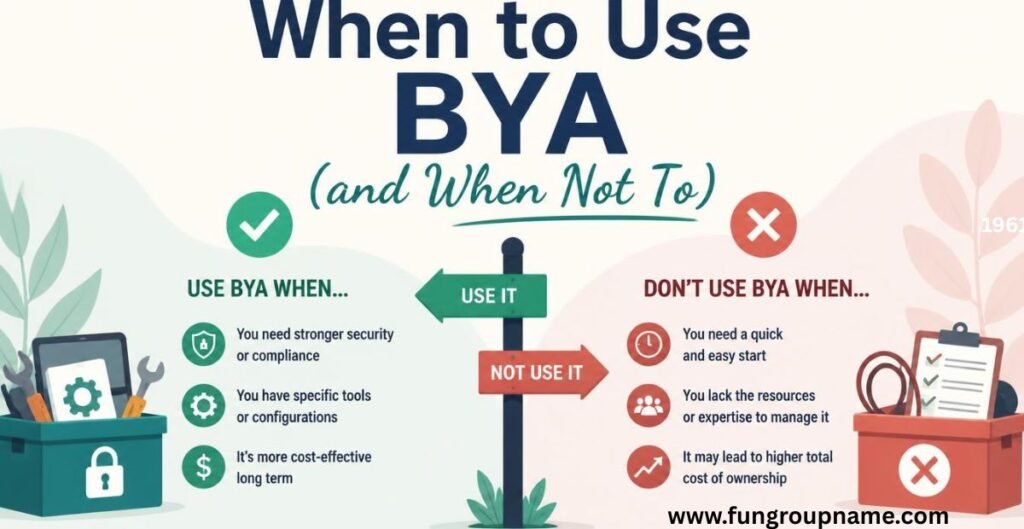
Use BYA only when the person you’re texting is likely to understand it. Because it isn’t a widely standardized abbreviation, spelling out the phrase is safer when clarity matters. A sender who knows the BYA meaning in text may assume you do too, and that gap is where most confusion starts.
Good times to use it:
- Casual chats with close friends who know your texting style.
- Quick sign-offs where “bye ya” is obvious from context.
- Playful banter where the tone is already clear.
Times to avoid it:
- Work emails and professional messages.
- School assignments or messages to teachers.
- Chats with parents, grandparents, or anyone who may not know the abbreviation.
- Any message where a misread could cause confusion or hurt feelings.
How to Reply When Someone Sends BYA
Match your reply to what you think the sender meant, and ask when you don’t know.
Casual replies
- “Haha, okay! 😄”
- “Got it, thanks!”
Funny replies
- “Wow, thanks for the preview 😂”
- “Okay okay, I asked for it.”
Polite replies
- “Thanks for letting me know!”
- “Appreciate the heads-up.”
When you’re not sure
- “Quick question: does BYA mean ‘bye’ or ‘because you asked’ here?”
Similar and Related Terms
These abbreviations often appear in the same kinds of chats as BYA:
- FYI: for your information
- BTW: by the way
- TBH: to be honest
- IMO: in my opinion
- ICYMI: in case you missed it
- IYKYK: if you know, you know
- AFAIK: as far as I know
- BRB: be right back
- BBL: be back later
- TTYL: talk to you later
- GTG: got to go
- L8R: later
Frequently Asked Questions
What is the BYA meaning in text?
BYA has no single standard meaning. It most often stands for “because you asked,” “before you ask,” “before you assume,” or a casual “bye ya,” and context tells you which one.
What does BYA mean in text from a guy, a boy, or a girl?
The possible meanings are the same no matter who sends it. The sender’s gender doesn’t change the abbreviation. Look at the tone, the emoji, and your relationship, and ask if you’re unsure.
What does “ima BYA” mean in text?
“Ima” is shorthand for “I’m gonna,” but I found no documented meaning for the full phrase. It depends on the chat’s context and tone, so the safest move is to ask the sender.
What does BYA mean on TikTok or Snapchat?
I couldn’t confirm a platform-specific meaning. On both apps it most plausibly works as a quick sign-off or a short reply, but check the surrounding context.
Is BYA Gen Z slang?
No source I found ties BYA to Gen Z. It appears in informal texting and social media, but there’s no usage data to say who uses it most.
Is BYA rude?
Not by itself. “Because you asked” can sound sharp without a friendly emoji, and one reported reading is a mildly vulgar joke, so tone matters. Read the full conversation before assuming anything.
Can BYA mean goodbye?
Yes. Some sources treat “bya” as a casual spelling of “bye ya,” and it usually appears at the end of a message.
Conclusion
BYA doesn’t have one confirmed meaning. The most likely readings are “because you asked,” “before you ask,” “before you assume,” and “bye ya,” and the context almost always points to the right one. Check where it sits in the message, notice the tone, and think about who sent it. If you’re still unsure, send a quick question instead of guessing.